Since I've been having a little bit of trouble updating this thing regularly, I've decided to go ahead and make some changes. The name is shortened, and the domain name is new.
Undoubtedly this will break some links. But I think it's worth it. This blog is still young.
Make no doubt: this changes the nature of this thing. I'm no longer writing about my D20 heartbreaker. Now I'm just going to write about fun stuff. If I come up with any new elements for my heartbreaker, I'll include them, of course.
There. Maybe now I'll be able to update this thing more regularly.
Saturday, June 30, 2012

Monday, June 25, 2012
Hello?
I having a little bit of trouble with this site for now. I might have to refocus it on some other topics if I'm going to keep updating it regularly.
By looking at my stats I can tell that my stone carrying capacity conversion chart is the only thing on here so far which has caught anybody's interest. Writing that was a lot of fun for me too. That's something to keep in mind.
By looking at my stats I can tell that my stone carrying capacity conversion chart is the only thing on here so far which has caught anybody's interest. Writing that was a lot of fun for me too. That's something to keep in mind.
Thursday, June 21, 2012
Some references
I'm come across someone who seems to really know his stuff about the medieval period. He's worth taking a look at here. Consider, for instance, this one: Did science make progress in the Middle Ages?
Saturday, June 16, 2012
Creating the setting, part 5: The Middle Ages is a foreign country
In part 4, I gave three options for the best real world analogy to the generic fantasy setting. Of these, generic fantasy adventures sometimes seem to take place in the first, sometimes the last, but almost never in the second. That is, although they're called "medieval," they actually carefully avoid being medieval. Why? I suppose the answer is that fantasy is imaginary, so it doesn't exist unless people are able to imagine it. Fantasy elements that aren't easy to understand, that don't feel natural to modern minds, don't get passed on. And modern people really can't understand the mindset of the Middle Ages.
We can imagine the Early Modern Period because it wasn't that long ago. Likewise, even though it was a long time ago, Roman antiquity, with its senators and milestones and public works projects, seems strangely familiar. The Dark Age is just the post-apocalyptic scenario of antiquity. Barbarian hordes are the period-appropriate equivalent of zombie hordes. Mad Max, The Road, and The Book of Eli are all essentially retellings of the downfall of the Roman Peace, or at least how we imagine it. (I suppose that's why the unlikely re-emergence of Christianity plays such a large role in post-apocalyptic fiction, since the Dark Ages was the period in which Christianity became dominant in the first place.)
The real Middle Ages, on the other hand, was a completely different society, with its own strange rules, beliefs, and assumptions. It's been said that the future is a foreign country. This must be true of the past, too. And it's hard to get together with a bunch of buddies and role-play life in a foreign country. How much does the average American really know about Egypt or Indonesia? That's why people travel.
I suppose this is why attempts to make "historically accurate" fantasy fail so bad. There never was any single historical period which fantasy was intended to reproduce. Introducing real elements of real medieval life (like prices and city life) only ends up making the vision more cumbersome and unnatural.
We can imagine the Early Modern Period because it wasn't that long ago. Likewise, even though it was a long time ago, Roman antiquity, with its senators and milestones and public works projects, seems strangely familiar. The Dark Age is just the post-apocalyptic scenario of antiquity. Barbarian hordes are the period-appropriate equivalent of zombie hordes. Mad Max, The Road, and The Book of Eli are all essentially retellings of the downfall of the Roman Peace, or at least how we imagine it. (I suppose that's why the unlikely re-emergence of Christianity plays such a large role in post-apocalyptic fiction, since the Dark Ages was the period in which Christianity became dominant in the first place.)
The real Middle Ages, on the other hand, was a completely different society, with its own strange rules, beliefs, and assumptions. It's been said that the future is a foreign country. This must be true of the past, too. And it's hard to get together with a bunch of buddies and role-play life in a foreign country. How much does the average American really know about Egypt or Indonesia? That's why people travel.
I suppose this is why attempts to make "historically accurate" fantasy fail so bad. There never was any single historical period which fantasy was intended to reproduce. Introducing real elements of real medieval life (like prices and city life) only ends up making the vision more cumbersome and unnatural.
Thursday, June 14, 2012
Creating the setting, part 4: Medieval or Dark Ages?
Let me apologize in advantage by saying I'm not a historian. There are people on the internet out there who are much better prepared than I am to discuss these matters. The word "medieval" is lazy and covers a multitude of faults. Does that mean early modern (Shakespearean/Renaissance) Europe, high-medieval Europe, or dark age Europe?
Once upon a time, historians regarded "middle ages" and "dark ages" as synonymous. More recently, though, historians have begun to restrict the term "dark ages" to the actual dark ages, so called for the lack of good historical records after the Roman Empire began its fall, that is, it's gradual descent down a slippery slope into depopulation and chaos. It didn't happen all of a sudden one day. People in the former Roman empire continued to speak Latin and think of themselves as Romans for a long time.
The middle ages, in comparison, is the period between the dark ages and the early modern era, "early modern era" being another name for the renaissance. That's roughly the period of Shakespeare/the Tudors/the grand age of sail.
The dates I'll be using will be Dark Ages (3rd century crisis to AD 800), Middle Ages (AD 800 - AD 1500), and Early Modern (1500 - 1800). Which of these do you like the best?
Dark Ages (before AD 800 or 900)
Medieval Period (800-1500)
Early Modern Era (1500 - 1800)
Once upon a time, historians regarded "middle ages" and "dark ages" as synonymous. More recently, though, historians have begun to restrict the term "dark ages" to the actual dark ages, so called for the lack of good historical records after the Roman Empire began its fall, that is, it's gradual descent down a slippery slope into depopulation and chaos. It didn't happen all of a sudden one day. People in the former Roman empire continued to speak Latin and think of themselves as Romans for a long time.
The middle ages, in comparison, is the period between the dark ages and the early modern era, "early modern era" being another name for the renaissance. That's roughly the period of Shakespeare/the Tudors/the grand age of sail.
The dates I'll be using will be Dark Ages (3rd century crisis to AD 800), Middle Ages (AD 800 - AD 1500), and Early Modern (1500 - 1800). Which of these do you like the best?
Dark Ages (before AD 800 or 900)
- Also known as "Late Antiquity," especially in German (Spaetantike)
- Set in the barbarian lands outside of the Roman frontier or during the fall of the Roman Empire
- Frontier between barbarians (peregrines, goths, vandals) and the (remaining) Roman Empire
- A vestigial empire who left behind monumental architecture like bridges, roads, aqueducts, and so on.
- Robes, togas, chainmail dresses, banded armor
- Torches and lamps
- Wooden motte-and-bailey castles and dirt walls, built quickly and not designed to be permanent
- Christianity is one religion among many, rapidly growing but also facing occasional prosecution
- Legendary saints, monks, and martyrs roam the land
- Roman numerals, abacuses
- Scrolls, codices, papyrus
- Short swords, spears, axes, discuses, franciscas, and war hammers
- Very limited technology - keys and locks, treadwheels, carriage-axle odometers, screw presses, isolated cases of geared calculators
- Time kept mostly by sundials and clepsydras.
- Waterpower and slavepower but no windpower
- Bronze is still superior to iron
Medieval Period (800-1500)
- Also known as the "High Middle Ages"
- The crusades against infidels and heretics
- Frontier between Christianity and Islam in the east and in the Iberian peninsula
- Chivalry, romantic love, quests, tournaments
- Tunics, foolscaps, nights in full plate armor, cannons
- Candlesticks, soap
- Stone castles with square towers, designed for practical defense
- The Catholic church develops
- Religious orders, early universities
- Witches are considered a superstition
- Arabic numerals, algorism
- Books and cheap paper, surprisingly high levels of literacy
- Proper broadswords, tiny heater shields
- Clever, but overly large and handmade mechanical devices - mills, looms, traps, etc
- Windpower developed, and horsepower harnessed more effectively, take some of the pressure off slaves
- Refined steel available, superior to bronze
- Fitted stone walls, wells, and castles
- Byzantium survives in Southwest Europe and Asia minor
Early Modern Era (1500 - 1800)
- Also called the Golden Age of Piracy, the Age of Exploration, or the Age of Mercantilism
- The inquisition (which actually stuck around until 1834)
- Conflict between natives and colonists, not just in the New World, but also in Russia, Ireland, the Canary Islands, and North Africa
- Competition between seabound Western Europe and landbound Eastern Europe empires
- Western Europe modernizes rapidly while in Eastern Europe the Holy Roman Empire goes into decline, eclipsed by the upstart Russian Empire and the Islamic Ottoman Empire
- Kings, queens, princes, princesses
- Oil lamps and lanterns
- Poor hygiene caused by overpopulation, periodic flare ups of plague
- Shakespeare, Goethe, Schiller
- Grand, Disney-style castles designed more for show than for function, with luxurious living quarters and round towers
- Fencing, boxing, and kickboxing (savate)
- The Reformation brings the concept of redemption by faith alone and sola scriptura, which shifts Christianity from a universal, works-based church into a national, intellectually-focused religion
- Witchhunts begin
- Logarithms and calculus
- Muskets
- Rapiers, bucklers, bracers, and polearms
- Newspapers, journals, pamphlets, beautifully bound printed books
- Beginnings of mechanical revolution - clockwork, cotton gins
- Miniaturized watches and pendulum clocks
- High quality wooden boxes, trunks, chests, and barrels (the sorts of things you picture filled with treasure)
- Silver dollars, also known as doubloons or pieces of eight
Monday, June 11, 2012
Non-combat level advancement
Level-based character advancement systems suck. I'm beginning to think that this is because they usually only offer one dimension of character advancement. Everything has to be shoehorned into that system. Either it makes you slightly better at fighting, or it's associated somehow with making you better at fighting, or the rules ignore it. You move up a level, you float around in limbo, or you die.
This is usually portrayed as a problem with awarding experience. True, the DM can be told to arbitrarily award additional "roleplaying" experience points. While it's nice to be recognized, this isn't a very good solution. Among other reasons, if a player's style involves a lot of roleplaying, combat-avoidance, and creative thinking, then they get a lot less out of additional experiences points than a pure hack-and-slasher does. Roleplaying experience points amount to the minimum you can do to address the problem.
So why don't we measure combat advancement and non-combat advancement separately?
It's exciting to think what separate non-combat experience points could do as part of a robust, unified mechanic. Instead of one "class" level, a character would have two, a combat class and a non-combat class, or "career." Moving up a level one's career could involve a better reputation, a higher social standing, more earning power, a higher standard of living, and generally more pull in social situations.
You could choose a career, just as you do an adventurer's class, that determines the details of the advancement. Of course, some careers would have level limits. No matter how good a milliner or executioner you are, you're not going to become king.
You could choose a career, just as you do an adventurer's class, that determines the details of the advancement. Of course, some careers would have level limits. No matter how good a milliner or executioner you are, you're not going to become king.
And yes, I've thought about skill-based systems, but I don't think those are the answer. Skill-based systems are too granular and choosing skills is a separate sub-game with its own pitfalls and complications. All you really need, I think, is the minimal differentiation between combat-based and non-combat character advancement.
First draft of career rules
First draft of career rules
There are two types of experience points: career experience points and combat experience points. Career experience points are awarded for good roleplaying or for spending time on your career in-game, or for other miscellaneous situations which involve no serious threat of death. Combat experience points are awarded for facing life-threatening danger. Career points are used for advancing in your career, and combat experience points are used for advancing in combat class, but not in career. Optionally, the DM may allow players to exchange career XP for combat XP or vice versa at a rate of 2 or 3 to 1.
The profession, craft, knowledge, and perform skills, and the NPC classes, are gone, as are certain feats like leadership, replaced by careers. These careers include: craftsman, expert, gentleman, granger, hunter, merchant, officer, performer, scholar, servant, and thief, plus whatever prestige careers (like royalty or dungeon engineer) your game setting requires. These careers are broad. A burgher is a small-town shopkeeper, baker, or butcher. Expert covers most uses of the profession skill, hunter includes fishermen as well as trappers, granger includes orchard-keepers, farmers, and shepherds, and officer includes any organization with a hierarchy and meritocratic promotion: soldiers, sailors, public servants, and police constables.
A character's career level limits the rate at which he can earn money, as well as the maximum amount of money he can retain between adventures. Sums in excess of this amount are assumed to have been spent on everyday expenses, like wine, women, and song. Career level also effects the number of followers and hirelings you can have. Each career has a number of career skills, for which one-half the career level may be added as a bonus to the skill roll.
Sunday, June 10, 2012
Dry measures are actually measurements of weight at constant density
Dry measures are most commonly used for measuring grain, and the most relevant statistic of grain is its weight. Historically, weighing big containers of grains was difficult, so people ended up estimating weight indirectly, from volume. The actual system of commodity baskets used in the United States now is quite complicated, but the general principle is that a "bushel" is a measuring basket intended for estimating the weight of a particular commodity.
US commodity bushels are too intimidating to actually use. But a fantasy world, being a fantasy world, allows us to simplify. So let's go ahead and assume that the people of that world classify bushels by the density of the material they're meant to measure, and choose the right sized one so that it will measure out approximately 50 compromise pounds (A "compromise pound" is just a name I came up with in a previous post for a nonspecific pound somewhere in the order of magnitude of one metric pound).
Bushels would presumably be classified by inches, that is, the depth in inches of a bushel with a one square-foot floor (I don't know of any historical source that does this, but it makes sense). This number is just twelve times the specific volume (cubic centimeters per gram, or pints per pound). For example, if you have a substance half as dense as water (1/2), its specific volume is double (2), and uses a 24-in (2 x12) bushel.
The common hulled grains (wheat, rice, and cracked corn), are all around 4/5 as dense as water, which gives of bushel depth of about 15 inches. This translate into 1.25 cubic feet, or 35 liters, which is very close to the official American dry bushel of 1.24 cubic feet, unless I've gotten my math wrong.
Chart 1: Approximate volume of 15-in "dry" bushels and related measures
1 ton = 10 cmb = 40 bsh (= ca. 50 cu ft, 1400 L)
1 quarter ton = 10 bsh (= ca. 12.5 cu ft, 350 L)
1 dry coomb = 4 bsh (= ca. 5 cu ft, 140 L)
1 dry streck = 2 bsh (= ca. 2.5 cu ft, 70 L)
1 dry bushel = 4 dry pecks = 100 dry cups (= ca. 1.25 cu ft, 35 L)
1 dry peck = 1/4 dry bushel = 25 dry cups (= ca. 540 cu in, 8.75 L)
(subunits from here on are the same as fluid measures. Follow the example of the dry cups)
Chart 2: Bushels of weight and related measures
1 ton = 10 cmb = 40 bsh (= 2000 co lbs, 1000 kg)
1 quarter ton = 10 bsh (= 500 co lbs, 250 kg)
1 coomb = 4 bsh (= 200 co lbs, 100 kg)
1 streck = 2 bsh (= 100 co lbs, 50 kg)
1 bushel = 4 pecks = 100 dry cups (= 50 co lbs, 25 kg)
1 peck = 1/4 bushel = 25 dry cups (= 12.5 co lbs, 6.25 kg)
(subunits from here on are the same as fluid measures. Follow the example of the dry cups)
US commodity bushels are too intimidating to actually use. But a fantasy world, being a fantasy world, allows us to simplify. So let's go ahead and assume that the people of that world classify bushels by the density of the material they're meant to measure, and choose the right sized one so that it will measure out approximately 50 compromise pounds (A "compromise pound" is just a name I came up with in a previous post for a nonspecific pound somewhere in the order of magnitude of one metric pound).
Bushels would presumably be classified by inches, that is, the depth in inches of a bushel with a one square-foot floor (I don't know of any historical source that does this, but it makes sense). This number is just twelve times the specific volume (cubic centimeters per gram, or pints per pound). For example, if you have a substance half as dense as water (1/2), its specific volume is double (2), and uses a 24-in (2 x12) bushel.
The common hulled grains (wheat, rice, and cracked corn), are all around 4/5 as dense as water, which gives of bushel depth of about 15 inches. This translate into 1.25 cubic feet, or 35 liters, which is very close to the official American dry bushel of 1.24 cubic feet, unless I've gotten my math wrong.
Chart 1: Approximate volume of 15-in "dry" bushels and related measures
1 ton = 10 cmb = 40 bsh (= ca. 50 cu ft, 1400 L)
1 quarter ton = 10 bsh (= ca. 12.5 cu ft, 350 L)
1 dry coomb = 4 bsh (= ca. 5 cu ft, 140 L)
1 dry streck = 2 bsh (= ca. 2.5 cu ft, 70 L)
1 dry bushel = 4 dry pecks = 100 dry cups (= ca. 1.25 cu ft, 35 L)
1 dry peck = 1/4 dry bushel = 25 dry cups (= ca. 540 cu in, 8.75 L)
(subunits from here on are the same as fluid measures. Follow the example of the dry cups)
Chart 2: Bushels of weight and related measures
1 ton = 10 cmb = 40 bsh (= 2000 co lbs, 1000 kg)
1 quarter ton = 10 bsh (= 500 co lbs, 250 kg)
1 coomb = 4 bsh (= 200 co lbs, 100 kg)
1 streck = 2 bsh (= 100 co lbs, 50 kg)
1 bushel = 4 pecks = 100 dry cups (= 50 co lbs, 25 kg)
1 peck = 1/4 bushel = 25 dry cups (= 12.5 co lbs, 6.25 kg)
(subunits from here on are the same as fluid measures. Follow the example of the dry cups)
Saturday, June 9, 2012
Keeping track of ammunition
I was just reading a Papers and Pencils article on stuff that never works in RPG's. That sounds like a challenge to me! One of the things on the list was limited ammunition.
Now, I understand that if your quiver holds scores of arrows, it's a lot of trouble to keep track of. You can't expect players to keep erasing and re-writing a number on their character sheets every six seconds of combat. But there's an easier way.
Every time a player rolls a natural 1 or 20 on their attack roll for a missile weapon, or any other weapon that involves keeping track of ammunition, have them make a tally mark in the margin of the character sheet. This is the trick. Not Arabic numbers, only tally marks, and no subtracting anything, only counting upwards. Tallying and comparing to another number is easier than subtracting. Divide the quiver's capacity by 10. This is the maximum number of tally marks there can be.
For instance, let's say you have an archer whose quiver holds 50 arrows. Then if, in the middle of combat, he reaches five tally marks (which looks like four vertical lines under a diagonal stroke, representing 50 arrows), he's run out. This is equally likely to happen following a hit (if you roll a twenty) or after a miss (if you roll a one). When you resupply, you just erase the tally marks and you're good to go again.
Of course, you might want to keep track of special magic arrows separately, one tally mark per magic arrow.
That's it. It's easy to keep track of this because natural 1's and 20's are special events (criticals and fumbles) that players are already on the lookout for. You don't need to remember a DC or make separate rolls for randomly running out.
Now, I understand that if your quiver holds scores of arrows, it's a lot of trouble to keep track of. You can't expect players to keep erasing and re-writing a number on their character sheets every six seconds of combat. But there's an easier way.
Every time a player rolls a natural 1 or 20 on their attack roll for a missile weapon, or any other weapon that involves keeping track of ammunition, have them make a tally mark in the margin of the character sheet. This is the trick. Not Arabic numbers, only tally marks, and no subtracting anything, only counting upwards. Tallying and comparing to another number is easier than subtracting. Divide the quiver's capacity by 10. This is the maximum number of tally marks there can be.
For instance, let's say you have an archer whose quiver holds 50 arrows. Then if, in the middle of combat, he reaches five tally marks (which looks like four vertical lines under a diagonal stroke, representing 50 arrows), he's run out. This is equally likely to happen following a hit (if you roll a twenty) or after a miss (if you roll a one). When you resupply, you just erase the tally marks and you're good to go again.
Of course, you might want to keep track of special magic arrows separately, one tally mark per magic arrow.
That's it. It's easy to keep track of this because natural 1's and 20's are special events (criticals and fumbles) that players are already on the lookout for. You don't need to remember a DC or make separate rolls for randomly running out.
Thursday, June 7, 2012
Alternate experience point systems
The D20 system reference document doesn't include an experience point chart or character advancement rules, so you have to add your own. Of course, I have my own provisional system (which I might more about later sometime), but my system can always be improved. One of its problems is that it relies heavily on DM's judgment when to roll.
So I got to looking at the Sweet20 experience system. Have you heard of that? It moves beyond free form experience points by creating rules for when the DM should hand out experience, not just vague suggestions about moving up after a fixed number of sessions or encouraging good roleplaying. It's an interesting system that seems vaguely familiar, like I've encountered something similar before.
The way Sweet20 works is that each character is customized with a list of goals, or "keys," as they're called. These keys describe what each character is trying to accomplish. Every session, each character receives experience points for accomplishing these goals. The more difficult or dangerous, the more experience you get. You get extra points for progressive character arcs (changing your goals over time). Another twist is that you can temporarily lose experience for violating your keys.
It sounds good, but I've never play tested it, which makes me a little wary. Also, it seems to me it could use some tightening up. It needs a wider variety of keys, and I tend to think it should integrate with character classes and alignment somehow. Loyalty and law-abiding keys should really only be used by lawful character, for instance.
More than this, there's something gnawing at me about a system like this, but I can't quite think what it is. But I've got a lot of ideas rolling around in my head for improved social mechanics, and it's hard work. Maybe if I let it germinate something clever will eventually pop out.
So I got to looking at the Sweet20 experience system. Have you heard of that? It moves beyond free form experience points by creating rules for when the DM should hand out experience, not just vague suggestions about moving up after a fixed number of sessions or encouraging good roleplaying. It's an interesting system that seems vaguely familiar, like I've encountered something similar before.
The way Sweet20 works is that each character is customized with a list of goals, or "keys," as they're called. These keys describe what each character is trying to accomplish. Every session, each character receives experience points for accomplishing these goals. The more difficult or dangerous, the more experience you get. You get extra points for progressive character arcs (changing your goals over time). Another twist is that you can temporarily lose experience for violating your keys.
It sounds good, but I've never play tested it, which makes me a little wary. Also, it seems to me it could use some tightening up. It needs a wider variety of keys, and I tend to think it should integrate with character classes and alignment somehow. Loyalty and law-abiding keys should really only be used by lawful character, for instance.
More than this, there's something gnawing at me about a system like this, but I can't quite think what it is. But I've got a lot of ideas rolling around in my head for improved social mechanics, and it's hard work. Maybe if I let it germinate something clever will eventually pop out.
Creating the setting, part 3: World maps are bad
One of the easiest traps to fall into when designing a game world is to create a world map. First of all, the map is two-dimensional, while the path that your players take is one-dimensional, so there's going to be a lot of wasted effect.
World maps also tend to have unrealistic scales for a world where traveling was a difficult undertaking, like sailing around the world on your own private yacht or backpacking across South America. Having reliable information about places hundreds or thousands of miles away just doesn't reflect pre-modern cartography. The farther away something was, the more fact and myth would be mixed. A bad geographical information roll table would be fun - the dragon-infested waters, magical barriers, countries of giants and amazons, mythical paradises, honey, and so on.
Lastly, the world belongs to everyone, not just the dungeon master. Locating everything ahead of time makes the DM proud and inflexible. One of the unexpectedly clever suggestions I found in the D&D 4E core books was letting the players dictate the aspects of world with successful knowledge rolls (of course, on unsuccessful rolls you tweak the world without letting them know).
I'm primarily talking about maps. You should still think about the order of magnitude of distances to famous locations, what countries lie in each compass directions, and a vague sense of latitude and continentality (which affect climate). The point, though, is to use just-in-time world building between sessions. There's generally enough time to determine the locations of things, if you've already got the hard parts (stats of generic creatures and floorplans and such) written up ahead of time and ready to be re-skinned.
If you have so much information that you can't convey it verbally or on a sketchy impromptu map, then you have too much. Of course, feel free to disagree.
World maps also tend to have unrealistic scales for a world where traveling was a difficult undertaking, like sailing around the world on your own private yacht or backpacking across South America. Having reliable information about places hundreds or thousands of miles away just doesn't reflect pre-modern cartography. The farther away something was, the more fact and myth would be mixed. A bad geographical information roll table would be fun - the dragon-infested waters, magical barriers, countries of giants and amazons, mythical paradises, honey, and so on.
Lastly, the world belongs to everyone, not just the dungeon master. Locating everything ahead of time makes the DM proud and inflexible. One of the unexpectedly clever suggestions I found in the D&D 4E core books was letting the players dictate the aspects of world with successful knowledge rolls (of course, on unsuccessful rolls you tweak the world without letting them know).
I'm primarily talking about maps. You should still think about the order of magnitude of distances to famous locations, what countries lie in each compass directions, and a vague sense of latitude and continentality (which affect climate). The point, though, is to use just-in-time world building between sessions. There's generally enough time to determine the locations of things, if you've already got the hard parts (stats of generic creatures and floorplans and such) written up ahead of time and ready to be re-skinned.
If you have so much information that you can't convey it verbally or on a sketchy impromptu map, then you have too much. Of course, feel free to disagree.
Wednesday, June 6, 2012
Creating the setting, part 2: Giving things up
When you create a setting for a game, it's important to resist the temptation to just pile everything on, like an all-you-can-eat buffet. You want the world to seem appealing and inviting, but you don't want things to become so complex that it starts to seem like a genre-mixing super hero team. Some great tastes do not taste great together.
A good example is the introduction of new sentient races. Supplements and expansions do this all the time, and it gets to be annoying, because it effectively involves a massive act of retroactive continuity.
"Oh, did we forget to tell you? Our planet also supports a highly sophisticated species of sentient cat people, who are well enough integrated into human society to speak our language and basically share our same technology, social structure, and pop culture."
I don't know about you, but if I were walking down the street and suddenly encountered someone made out of living crystal or a bipedal dinosaur wearing a hoodie and buying a soda from the machine next to Wal*Mart, the least likely possible explanation I could think of would be that the Earth has however supported a separate humanoid species for the 10 million years or so we'd both been evolving, and that not only had we not killed each other off competing for resources, but I'd never bumped into them before that moment. But that's the basically the explanation we're given for the introduction into the storyline of swanmays, minotaurs, dragonborn, Eladrin, gnomes, pixies, nagas, or whatever they're coming up with now in the popular RPG's.
This sort of stuff needs to be decided ahead of time. At least Tolkien made an effort to explain how the gods created the various races, and that orcs go into hibernation and can survive buried underground for thousands of years until mortal memory of them is forgotten. But then, most fantasy is a far cry from Tolkien.
A good example is the introduction of new sentient races. Supplements and expansions do this all the time, and it gets to be annoying, because it effectively involves a massive act of retroactive continuity.
"Oh, did we forget to tell you? Our planet also supports a highly sophisticated species of sentient cat people, who are well enough integrated into human society to speak our language and basically share our same technology, social structure, and pop culture."
I don't know about you, but if I were walking down the street and suddenly encountered someone made out of living crystal or a bipedal dinosaur wearing a hoodie and buying a soda from the machine next to Wal*Mart, the least likely possible explanation I could think of would be that the Earth has however supported a separate humanoid species for the 10 million years or so we'd both been evolving, and that not only had we not killed each other off competing for resources, but I'd never bumped into them before that moment. But that's the basically the explanation we're given for the introduction into the storyline of swanmays, minotaurs, dragonborn, Eladrin, gnomes, pixies, nagas, or whatever they're coming up with now in the popular RPG's.
This sort of stuff needs to be decided ahead of time. At least Tolkien made an effort to explain how the gods created the various races, and that orcs go into hibernation and can survive buried underground for thousands of years until mortal memory of them is forgotten. But then, most fantasy is a far cry from Tolkien.
Monday, June 4, 2012
Carrying capacity converted to stones
This post gives you a table for use with the stone encumbrance system found at Delta's D&D blog, and also to my own previous expansion of the system. The table lets you use stone units with newer D20 games, rather that just the original Dungeons & Dragons. It is meant to replace the carrying capacity table from the D20 or Pathfinder system reference document.
This table gives, by STR score, the maximum amount a character can lift, in stone units, and also provides a translation into kilograms based on my own slightly fudged conversion of 6.25 kg per stone. Conversion to pounds is not given, because it's my contention that you really don't need to know that and that it only gives you the illusion of precision.
It was easier than I thought it'd be to convert the chart. My chart is linear until STR 14 (that is, STR 14 is 14 stones of maximum lift), whereas the SRD chart stops being linear after STR 10. It's really a feature if you have to consult the table less often.
You only really have to remember scores 15 through 19 or 20. After that, the relationship is exponential, meaning that the maximum lift is simply double that of a STR score five points lower. The table is divided into groups of five so you can see this for yourself. Also, STR scores above 24 recap the weights 10 points lower, but in units of talents instead of stones. That's also been indicated on the table.
Short table
(before this point max. lift = STR)
15: 16 st = 100 kg
16: 18 st = 113 kg
17: 20 st = 125 kg
18: 24 st = 150 kg
19: 28 st = 175 kg
20: 32 st = 200 kg
(after this point, maximum lift doubles for every five additional points of strength)
Fuller table
STR Maximum lift
1: 1 st = 6 kg
2: 2 st = 13 kg
3: 3 st = 19 kg
4: 4 st = 25 kg
5: 5 st = 31 kg
6: 6 st = 38 kg
7: 7 st = 44 kg
8: 8 st = 50 kg
9: 9 st = 56 kg
10: 10 st = 63 kg
11: 11 st = 69 kg
12: 12 st = 75 kg
13: 13 st = 81 kg
14: 14 st = 88 kg
15: 16 st = 100 kg
16: 18 st = 113 kg
17: 20 st = 125 kg
18: 24 st = 150 kg
19: 28 st = 175 kg
20: 32 st = 200 kg
21: 9 tlt = 36 st = 225 kg
22: 10 tlt = 40 st = 250 kg
23: 12 tlt = 48 st = 300 kg
24: 14 tlt = 56 st = 350 kg
25: 16 tlt = 64 st = 400 kg
26: 18 tlt = 72 st = 450 kg
27: 20 tlt = 80 st = 500 kg
28: 24 tlt = 96 st = 600 kg
29: 28 tlt = 112 st = 700 kg
30: 32 tlt = 128 st = 800 kg
31: 36 tlt = 144 st = 900 kg
32: 40 tlt = 160 st = 1000 kg
33: 48 tlt = 192 st = 1200 kg
34: 56 tlt = 224 st = 1400 kg
35: 64 tlt = 448 st = 1600 kg
+5: x2
+10: x4
This table gives, by STR score, the maximum amount a character can lift, in stone units, and also provides a translation into kilograms based on my own slightly fudged conversion of 6.25 kg per stone. Conversion to pounds is not given, because it's my contention that you really don't need to know that and that it only gives you the illusion of precision.
It was easier than I thought it'd be to convert the chart. My chart is linear until STR 14 (that is, STR 14 is 14 stones of maximum lift), whereas the SRD chart stops being linear after STR 10. It's really a feature if you have to consult the table less often.
You only really have to remember scores 15 through 19 or 20. After that, the relationship is exponential, meaning that the maximum lift is simply double that of a STR score five points lower. The table is divided into groups of five so you can see this for yourself. Also, STR scores above 24 recap the weights 10 points lower, but in units of talents instead of stones. That's also been indicated on the table.
Short table
(before this point max. lift = STR)
15: 16 st = 100 kg
16: 18 st = 113 kg
17: 20 st = 125 kg
18: 24 st = 150 kg
19: 28 st = 175 kg
20: 32 st = 200 kg
(after this point, maximum lift doubles for every five additional points of strength)
Fuller table
STR Maximum lift
1: 1 st = 6 kg
2: 2 st = 13 kg
3: 3 st = 19 kg
4: 4 st = 25 kg
5: 5 st = 31 kg
6: 6 st = 38 kg
7: 7 st = 44 kg
8: 8 st = 50 kg
9: 9 st = 56 kg
10: 10 st = 63 kg
11: 11 st = 69 kg
12: 12 st = 75 kg
13: 13 st = 81 kg
14: 14 st = 88 kg
15: 16 st = 100 kg
16: 18 st = 113 kg
17: 20 st = 125 kg
18: 24 st = 150 kg
19: 28 st = 175 kg
20: 32 st = 200 kg
21: 9 tlt = 36 st = 225 kg
22: 10 tlt = 40 st = 250 kg
23: 12 tlt = 48 st = 300 kg
24: 14 tlt = 56 st = 350 kg
25: 16 tlt = 64 st = 400 kg
26: 18 tlt = 72 st = 450 kg
27: 20 tlt = 80 st = 500 kg
28: 24 tlt = 96 st = 600 kg
29: 28 tlt = 112 st = 700 kg
30: 32 tlt = 128 st = 800 kg
31: 36 tlt = 144 st = 900 kg
32: 40 tlt = 160 st = 1000 kg
33: 48 tlt = 192 st = 1200 kg
34: 56 tlt = 224 st = 1400 kg
35: 64 tlt = 448 st = 1600 kg
+5: x2
+10: x4
Why D20?
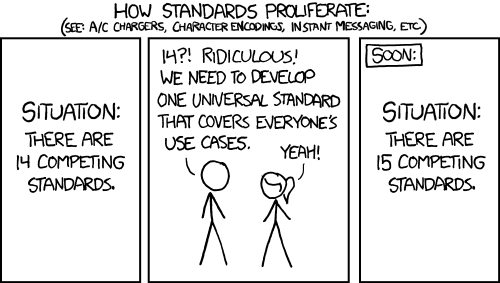
Why not invent my own system from scratch? The simple answer is, you don't have to reinvent the wheel.
This is why standards of all sorts arise, from the QWERTY keyboard, to Linux, to the 55-gallon drum.
 |
| You could be reading XKCD right now |
- The skill resolution system, the heart of D20, actually works really well. It's one roll, no look-up charts, with a simple rule (taking 20) that explains what to roll for and what not to roll for. It gives broadly realistic results. The probabilities are easier to figure out than exploding dice or dice pools. If it's not broke, why fix it?
- There are numerous supplements and expansions available with house-rules that fix other problems or re-flavor the game to taste. Some simplify, some add detail, but they all help cover the inevitable gaps and omissions, making the system deeper and more robust.
- The D20 system and generic fantasy milieu gives us a common vocabulary and point of reference. It gives us terms like difficulty class, base attack bonus, attributes, feats, rounds, and so on. Even generic setting material will probably make reference to gold pieces, silver pieces, and copper pieces. This is important when dealing with a world that isn't actually tangible. You don't want to complicate things by making people translate between one ruleset and another or between one set of jargon and another.
- Inheritance requires less play testing, because you only have to concentrate on the changes from the ancestral system.
- D20 supplemental material is relatively balanced. Where it isn't, it's easy to solicit accounts of playing with a given rule change or expansion or whatever.
This is why standards of all sorts arise, from the QWERTY keyboard, to Linux, to the 55-gallon drum.
Sunday, June 3, 2012
Extended human-scale weights and measures, heavier
As a supplement to my previous post on this topic, just for the sake of completeness I'd like to list the heavier weights, that is, the ones greater than a pound... Although they're perfectly predictable.
The last article established that four "stone" is a "talent." Of course, there are also 8 stones in a hundredweight. Dividing through by the four stones in a talent makes a hundredweight of two talents. Due to the ambiguity between an imperial hundredweight and a US customary hundredweight, let's name our unit of 100 a "centner."
This, the stone, the talent, and the centner, plus the regularly derived and well-known ton and quarter-ton, make a fairly comprehensive system for larger weights, with predictable relationships (halving or quartering) between them.
Weight is usually described roughly in tons, quarter tons, stones, pounds, or ounces (1 tn = 4 qtn = 160 st = 2000 co lb), depending on the context and order of magnitude. Each unit of measurement has its own connotations.
1 ton = 20 cwt = 40 tlt = 160 st = 4000 mk (= 2240 lbs avoirdupois, 1000 kg)
1 quarter-ton = 5 cwt = 10 tlt = 40 st = 1000 mk (= 560 lbs avoirdupois, 250 kg)
1 centner = 2 tlt = 8 stn = 100 co lb = 200 mk (=112 lbs avoirdupois, 50 kg)
1 talent = 4 st = 50 co lb = 100 mks = 800 ozt (= 56 lbs avoirdupois, 25 kg)
1 stone = 25 mk = 200 ozt = 1000 pc* (= 224 oz avoirdupois, 6.25 kg)
*pc stands for "pieces," a coin of standard weight.
The last article established that four "stone" is a "talent." Of course, there are also 8 stones in a hundredweight. Dividing through by the four stones in a talent makes a hundredweight of two talents. Due to the ambiguity between an imperial hundredweight and a US customary hundredweight, let's name our unit of 100 a "centner."
This, the stone, the talent, and the centner, plus the regularly derived and well-known ton and quarter-ton, make a fairly comprehensive system for larger weights, with predictable relationships (halving or quartering) between them.
Weight is usually described roughly in tons, quarter tons, stones, pounds, or ounces (1 tn = 4 qtn = 160 st = 2000 co lb), depending on the context and order of magnitude. Each unit of measurement has its own connotations.
- A weight enumerated in tons or quarter tons is apparently too heavy for anyone of less than superheroic strength to lift. A dairy cow weighs three quarter-tons. An adult african elephant weighs between 3 and 7 tons. A blue whale weighs 180 tons.
- A weight enumerated in talents is heavy enough that a person of average strength would generally prefer to ask for help moving it. A stout laborer can carry one talent by himself in both arms with affecting this movement speed. Incidentally, a talent carried by two people comes out to one stone per hand.
- A weight enumerated in stones is heavy enough to be cumbersome, but not so heavy that it can't be lifted by one person.
- A weight enumerated in pounds or ounces is basically just flavor text, provided to help you visualizing the scene. The difference of one pound probably won't make any difference in regards to the game system. If your encumbrance system is that granular, it would probably be too nitpicky to actually use.
1 ton = 20 cwt = 40 tlt = 160 st = 4000 mk (= 2240 lbs avoirdupois, 1000 kg)
1 quarter-ton = 5 cwt = 10 tlt = 40 st = 1000 mk (= 560 lbs avoirdupois, 250 kg)
1 centner = 2 tlt = 8 stn = 100 co lb = 200 mk (=112 lbs avoirdupois, 50 kg)
1 talent = 4 st = 50 co lb = 100 mks = 800 ozt (= 56 lbs avoirdupois, 25 kg)
1 stone = 25 mk = 200 ozt = 1000 pc* (= 224 oz avoirdupois, 6.25 kg)
*pc stands for "pieces," a coin of standard weight.
Saturday, June 2, 2012
Extended human-scale weights and measures
Delta's D&D blog has brought it to my attention that stone units make a simple and convenient way of estimating encumbrance. He has a very good point, but sooner or later the situation will arise when we want to know weights to greater precision than multiples of 14 English pounds. This information helps to put you inside the heads of the locals. You never know when you might need to make conversions.
Here's an idea. A stone is close enough to 25 "marks" in the Troy system of weights that it makes no difference. By definition, each mark is divided into 8 troy ounces. This seems granular enough. Incidentally, this make four stones into almost exactly 100 marks, which is certainly convenient. We can call 100 marks a "talent," because it's approximately one Attic talent, the weight of a cubic foot of water. Thus, we can also define a mark as approximately 1% of the weight of a cubic foot of water, if you care about details like that.
Marks and ounces are the right size for food. A mark is the weight of a typical loaf of hearty brown bread, and one ounce is about the weight of a slice from that loaf. However, most heavy (dense) things smaller than one mark are measured in 1/5's of a troy ounce, which is a standard coinweight or "piece." This weight falls between that of a US quarter and the new dollar coin. Thus, a heavy sack of 1000 standard coins weighs one stone. This ratio is more realistic and convenient than the official ratio of 10 to the pound (which requires some very large coins). This is, of course, another advantage of using stone units.
As for pounds, I don't believe you should use them. Fantasy units of measurement should be somewhat exotic and not too well defined. But for those of you that must have your weights in pounds, let's define a "compromise pound" as one-hundredth part of an English hundredweight (that is, 1.12 English pounds, close to a metric pound), which is two marks. Convert a number from marks to pounds by halving it.
Table 1
1 talent = 4 st = 50 lb = 100 mk = 800 ozt (= 56 lbs avoirdupois, 25 kg)
1 stone = 25 mk = 200 ozt = 1000 pc (= 224 oz avoirdupois, 6.25 kg)
1 pound = 2 mk = 16 ozt = 80 pc (=1 T lb, 13.4 oz avoirdupois, 500 g)
1 mark = 1/2 lb = 8 ozt = 40 pc (= 2/3 T lbs, 6.7 oz avoirdupois, 250 g)
1 troy ounce = 5 pc (= 480 gr, 20 dwt, 31.25 g)
1 coinweight = 1/5 ozt (= 96 gr, 5 dwt, 6.25 g)
Table 2
0.0125 mk = 1/2 pc
0.025 mk = 1 pc
0.05 mk = 2 pc
0.1 mk = 4 pc
0.2 mk = 8 pc
0.5 mk = 1/4 lb
1.0 mk = 1/2 lb
2.0 mk = 1 lb
6.0 mk = 3 lb
10.0 mk = 5 lb
25.0 mk = 1 st
50.0 mk = 2 st
100.0 mk = 4 st
250.0 mk = 10 st
500.0 mk = 5 tlt
1000.0 mk = 10 tlt
2500.0 mk = 25 tlt
5000.0 mk = 50 tlt
Here's an idea. A stone is close enough to 25 "marks" in the Troy system of weights that it makes no difference. By definition, each mark is divided into 8 troy ounces. This seems granular enough. Incidentally, this make four stones into almost exactly 100 marks, which is certainly convenient. We can call 100 marks a "talent," because it's approximately one Attic talent, the weight of a cubic foot of water. Thus, we can also define a mark as approximately 1% of the weight of a cubic foot of water, if you care about details like that.
Marks and ounces are the right size for food. A mark is the weight of a typical loaf of hearty brown bread, and one ounce is about the weight of a slice from that loaf. However, most heavy (dense) things smaller than one mark are measured in 1/5's of a troy ounce, which is a standard coinweight or "piece." This weight falls between that of a US quarter and the new dollar coin. Thus, a heavy sack of 1000 standard coins weighs one stone. This ratio is more realistic and convenient than the official ratio of 10 to the pound (which requires some very large coins). This is, of course, another advantage of using stone units.
As for pounds, I don't believe you should use them. Fantasy units of measurement should be somewhat exotic and not too well defined. But for those of you that must have your weights in pounds, let's define a "compromise pound" as one-hundredth part of an English hundredweight (that is, 1.12 English pounds, close to a metric pound), which is two marks. Convert a number from marks to pounds by halving it.
Table 1
1 talent = 4 st = 50 lb = 100 mk = 800 ozt (= 56 lbs avoirdupois, 25 kg)
1 stone = 25 mk = 200 ozt = 1000 pc (= 224 oz avoirdupois, 6.25 kg)
1 pound = 2 mk = 16 ozt = 80 pc (=1 T lb, 13.4 oz avoirdupois, 500 g)
1 mark = 1/2 lb = 8 ozt = 40 pc (= 2/3 T lbs, 6.7 oz avoirdupois, 250 g)
1 troy ounce = 5 pc (= 480 gr, 20 dwt, 31.25 g)
1 coinweight = 1/5 ozt (= 96 gr, 5 dwt, 6.25 g)
Table 2
0.0125 mk = 1/2 pc
0.025 mk = 1 pc
0.05 mk = 2 pc
0.1 mk = 4 pc
0.2 mk = 8 pc
0.5 mk = 1/4 lb
1.0 mk = 1/2 lb
2.0 mk = 1 lb
6.0 mk = 3 lb
10.0 mk = 5 lb
25.0 mk = 1 st
50.0 mk = 2 st
100.0 mk = 4 st
250.0 mk = 10 st
500.0 mk = 5 tlt
1000.0 mk = 10 tlt
2500.0 mk = 25 tlt
5000.0 mk = 50 tlt
Subscribe to:
Posts (Atom)