 |
| You could be reading XKCD right now |
- The skill resolution system, the heart of D20, actually works really well. It's one roll, no look-up charts, with a simple rule (taking 20) that explains what to roll for and what not to roll for. It gives broadly realistic results. The probabilities are easier to figure out than exploding dice or dice pools. If it's not broke, why fix it?
- There are numerous supplements and expansions available with house-rules that fix other problems or re-flavor the game to taste. Some simplify, some add detail, but they all help cover the inevitable gaps and omissions, making the system deeper and more robust.
- The D20 system and generic fantasy milieu gives us a common vocabulary and point of reference. It gives us terms like difficulty class, base attack bonus, attributes, feats, rounds, and so on. Even generic setting material will probably make reference to gold pieces, silver pieces, and copper pieces. This is important when dealing with a world that isn't actually tangible. You don't want to complicate things by making people translate between one ruleset and another or between one set of jargon and another.
- Inheritance requires less play testing, because you only have to concentrate on the changes from the ancestral system.
- D20 supplemental material is relatively balanced. Where it isn't, it's easy to solicit accounts of playing with a given rule change or expansion or whatever.
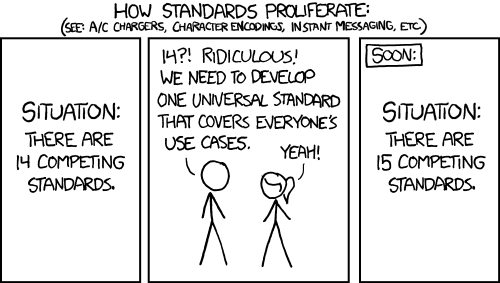
This is why standards of all sorts arise, from the QWERTY keyboard, to Linux, to the 55-gallon drum.

No comments:
Post a Comment